No-oil Cointrin, Geneva
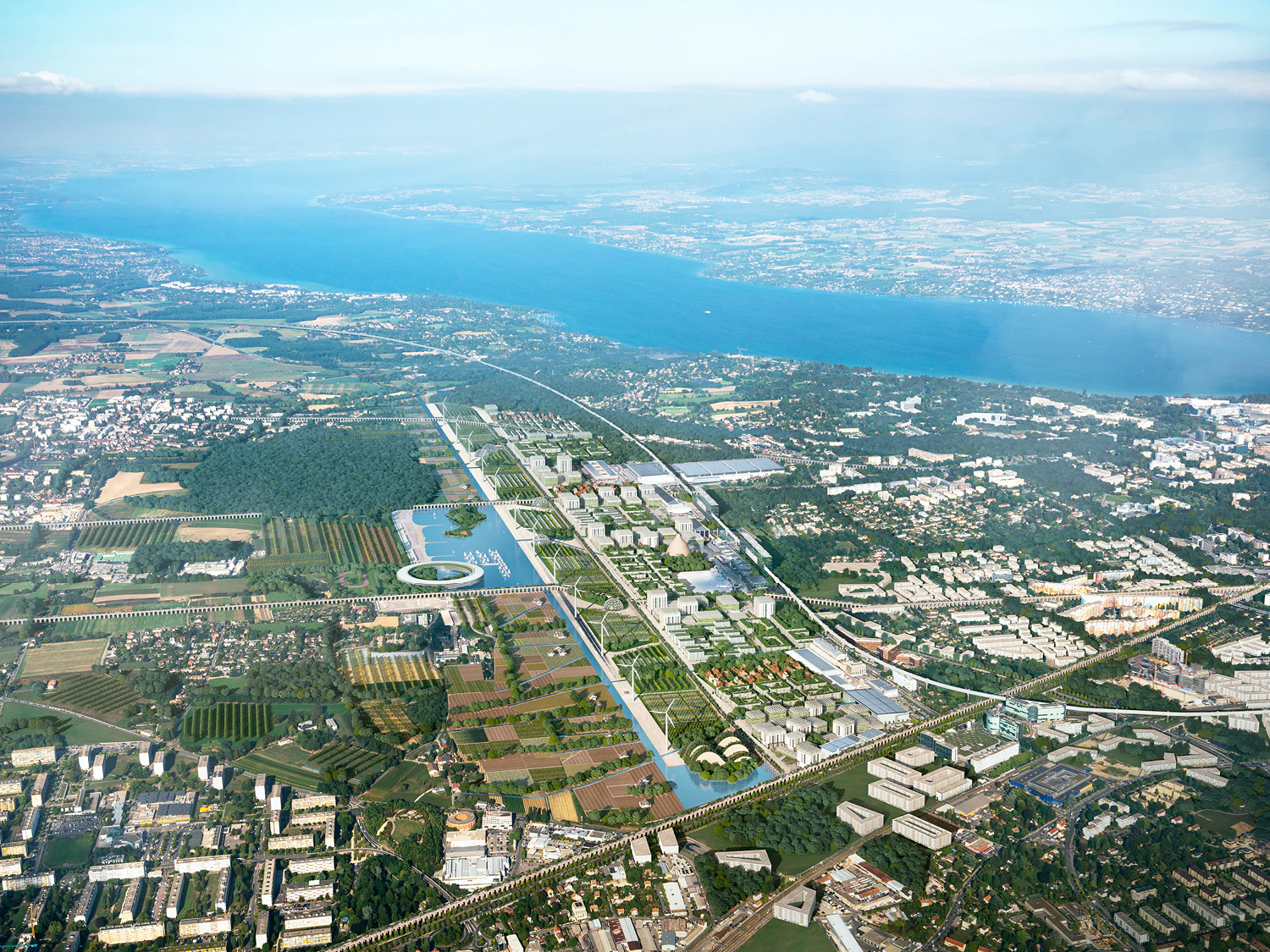

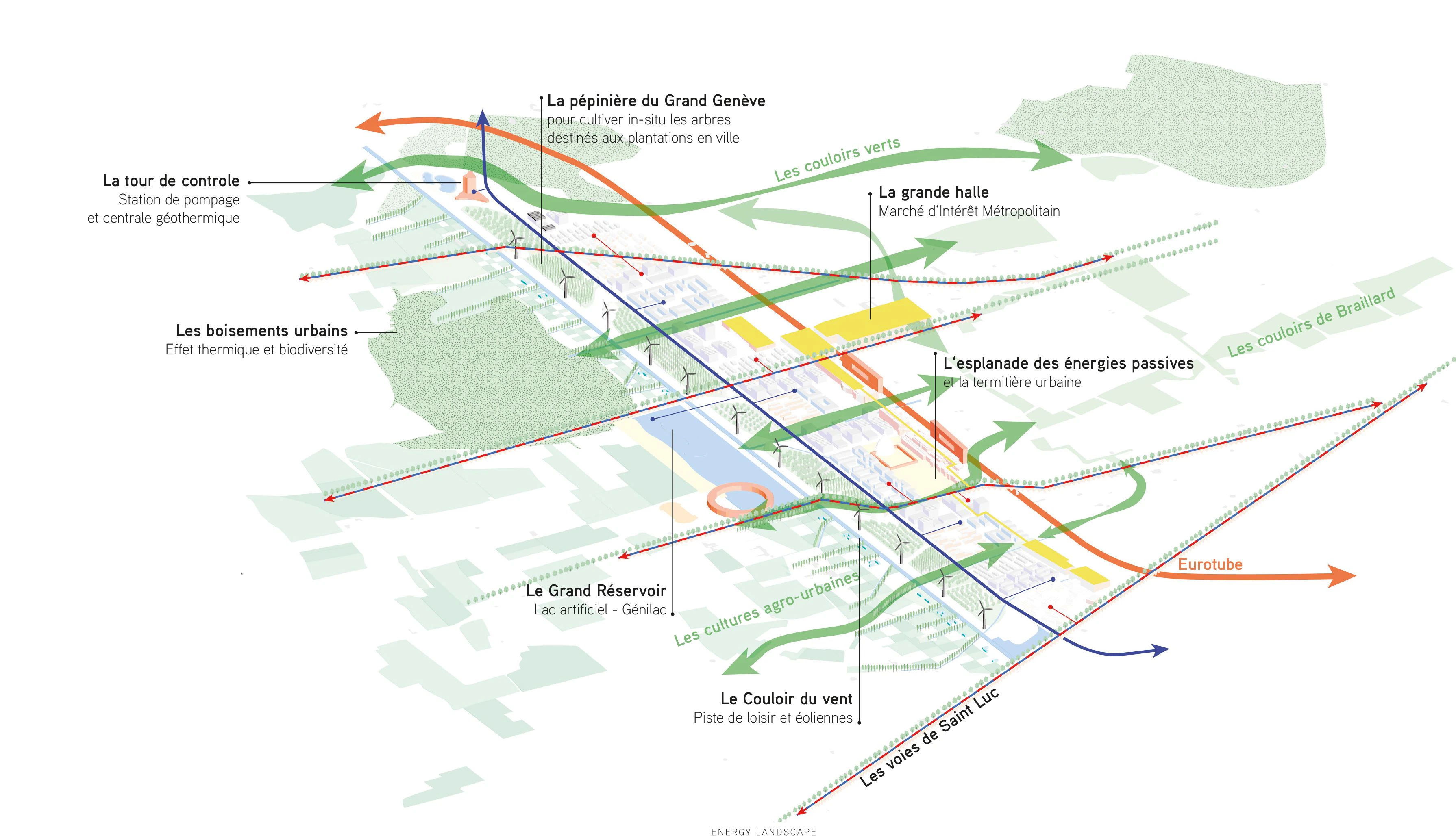
The no-oil Cointrin project is structured on local clean energy networks and on a climate network. It is a city of short paths, healthy and habitable, productive and qualitative and deeply linked to its energy landscape.
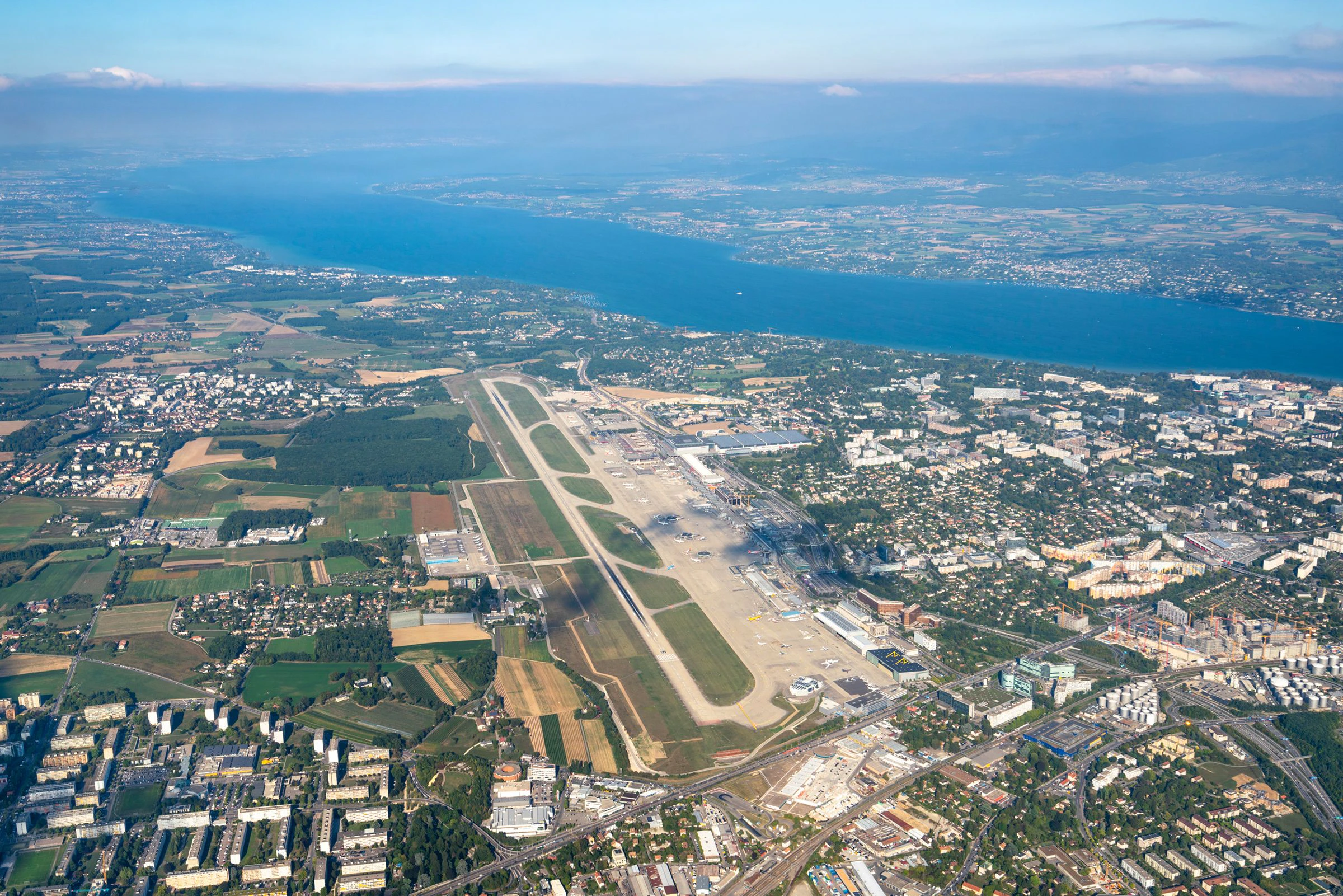
No-oil Cointrin also means completely changing the paradigm of people's movements, transforming a non-place for more than 17 million passengers a year into an environment rich in biodiversity for the 30,000 new inhabitants who live and work there. Transforming the Cointrin site into a new district of Greater Geneva means eliminating the largest consumer of fossil fuels from the landscape and giving the site the chance to produce clean energy and absorb CO2.
reconnecting with the soil
The transformation of the Cointrin site is based on the existing nature of the soils. Only the asphalt soils of the airstrips are densified to preserve the permeable spaces as much as possible. The new constructions offer "controlled permeability". Many roofs are suitable for above-ground crops and photovoltaic greenhouses. All buildings are connected to a central meteor water collection network, which is then returned to the valley system and the Large Reservoir.
Permeable soils are planted. In the center of the airport the rows of various trees form a productive nursery, and at the edge of the agricultural land orchards and farms complete the local food production system. Planting an urban nursery means absorbing the CO2 of Greater Geneva, and distributing trees in existing urban spaces with adapted species capable of positively conditioning the urban climate of the entire agglomeration. The distribution of trees throughout the territory will therefore have a positive climatic effect for Greater Geneva, the nursery will be a kind of urban air conditioner.
The nursery is habitable, it participates in the quality of public spaces, and shares its soil with the lines of the greenhouses in the open ground. In this integrative logic, we also propose agroforestry in the existing agricultural fields and the densification of the bocage system typical of the Pays de Gex. The superposition of landscape and agricultural structures is favorable to the urban climate, biodiversity and has a positive impact on CO2 absorption. In addition to being a productive area, it is also a Great Park with beautiful open esplanades in the spirit of the German Volkspark. Large climatic corridors cross the site.
a site connected to the world by a new generation transport network
The aviation crisis has triggered a new discourse on the European rapid transit network. Cointrin is linked internationally by the EuroTube, a less energy-intensive means of transportation with a smaller footprint. In a moderate scenario, capsules of 20 to 25 people could reach Zurich in 17 minutes. Zurich Airport, which has the greatest development potential and less pollution in the conurbation, will be able to take precedence in international air traffic from Switzerland. The transport network can colonize the network of high-voltage power lines, which offer spatial potential to complement the current overloaded rail network.
restructured green corridors
Wooded cordons cross from Cointrin and connect existing forests and wooded cordons with the "de Braillard" green corridors. These greenways play a major role in the urban microclimate since they extend the climatic qualities of the forests to the urbanized areas and have a positive influence against the urban heat island effect. A dense plantation of different species has a positive impact on biodiversity which will be able to find quality transition areas. In a post-covid-19 city, green corridors connect places of relaxation, which become accessible and combine the urban environment with the countryside by creating a continuity between built and vegetal.
the roads of Saint Luc, a walkable city
The life during the Covid-19 showed us the relevance of designing an efficient soft mobility network with an integrated local renewable energy network.
Generous covered lanes follow the existing mobility axes to connect the large landscape to the urbanized areas. The massiveness of the architecture allows to integrate the excavated earth of the canton of Geneva. Large massive arches support a tree-lined walkway in the open ground. These arcades are reminiscent of the portico of Saint Luke in Bologna. This innovative and vernacular solution will be able to reconcile a network of rapid soft mobility, protected by the weather, below the arches, with a network of tree-lined walks above the arches.
The high-performance soft mobility network is also the network that connects local energy production sites to consumption sites, and thus becomes a new aerial network of renewable and climatic energies.
the water network
The Cointrin site is structured by a water network, which collects rainwater, thermal water discharges and waterways currently channeled under the airstrips. New and neighboring districts and neighborhoods, such as the Meyrin pond, Vernier, Grand-Sacconex, etc., will be able to be connected directly to the Vengeron pumping station of the GéniLac network. The built structures connected to the system will thus be able to benefit from a cooling and heating system thanks to a thermal coupling. A Large Reservoir, serving as a watershed for excess water, will thus be created in the heart of the site.
A new agro-urban fauna and flora will be able to enrich the local biodiversity. A large leisure area will be created around the Large Reservoir. Thanks to an excellent connection by the Saint-Luc roads, this stretch of water could become a new leisure destination in Greater Geneva, thus completing the current offer. As we now know, the post-Covid-19 city and the post-oil city are cities where leisure activities can be enjoyed nearby. Waterways lined with real wooded cordons, continuous vegetation corridors, will form gullies favourable for rainwater management and irrigation of local crops.
type of mandate : Greater-Geneva Consultation
study period: 2020
programs: post-oil city, zero-carbon renewable energy production and consumption network, productive city, mobility network, housing, public spaces and facilities
site size: 225ha
project leads: Lucile Ado, Oscar Buson
architecture and urban planning: Raum404
landscape architecture: Lorenz Eugster
photography : Nicolas Sedlatchek
image : The Big Picture